
Part of our Home Espresso: The Complete Guide to Machines, Drinks & Technique series — browse every related guide in one place.
Disclosure: As an Amazon Associate, Grind Those Beans earns from qualifying purchases. We only recommend products we believe in.
Temperature is everything in espresso. Pull your shot even five degrees too hot and you’re drinking bitterness. Too cool and you get a sour, under-extracted mess. That’s exactly why PID controllers — the same technology used in laboratory equipment and commercial café machines — have become the must-have feature for serious home brewers. They don’t just set a temperature. They hold it, second by second, throughout your entire extraction.
Whether you’re chasing silky flat whites before work or experimenting with single-origin espresso on a Sunday morning, the machines on this list give you that tight thermal control without demanding a barista diploma. We’ve pulled together four options that cover a wide range of use cases and budgets, so you can find the one that actually fits your kitchen and your routine.
Why PID Temperature Control Changes Everything
A standard espresso machine uses a simple thermostat — it overshoots, undershoots, and overshoots again in a cycle. Your shot temperature can swing by 10°C or more between pulls. A PID controller (Proportional-Integral-Derivative) solves this by constantly reading the boiler temperature and making tiny adjustments to maintain a precise target — usually around 90–96°C, depending on your beans and roast level.
The real-world result? Consistent crema, repeatable flavor, and a genuine shot at dialing in your grind without chasing a moving temperature target. Coffee educator James Hoffmann has talked extensively about how brew temperature affects extraction yield — and even a two-degree swing can shift a balanced shot into under- or over-extracted territory. If you’re using quality beans and a good grinder, a machine without PID is genuinely holding you back. And if you’re wondering whether pre-ground coffee works in an espresso machine, temperature stability matters even more there — inconsistency compounds fast when the grind isn’t perfectly fresh.
What We Look for in a PID Espresso Machine
Beyond the PID itself, we care about a few core things: boiler quality (thermoblock vs. single boiler vs. dual boiler), pump pressure (15–20 bar peak, with 9 bar at the puck being the real target), ease of steam wand use for milk drinks, and how much countertop real estate you’re giving up. Workflow matters too — a machine that takes 20 minutes to warm up or requires constant fiddling won’t get used. For machines that bundle a grinder with the brew head, we looked at our top picks for coffee machines with steam wand and grinder as a reference point. Value for money rounds it all out.
Top 4 Espresso Machines with PID
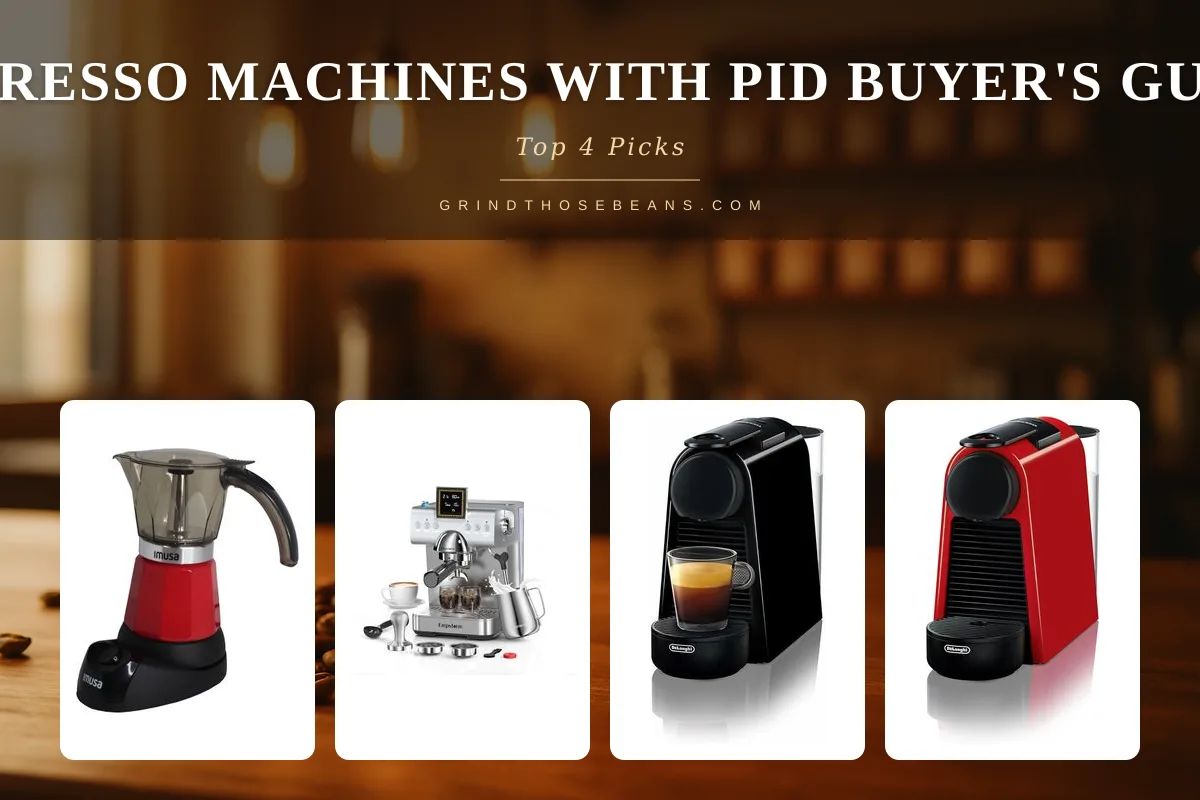
Ready to find your match? Here are the four best espresso machines with PID temperature control for home use right now — ranging from a dead-simple capsule brewer to a full-featured semi-automatic with a live pressure gauge. Each one earns its spot for a different reason.
| Category | Product | Price | Why it wins | Link |
|---|---|---|---|---|
| Best Overall | Empstorm 20 Bar Espresso Machine | $$$ | Real PID display and pro-level control at an accessible price. | View on Amazon → |
| Best for Beginners | Nespresso Essenza Mini (Red) | $$$ | Zero learning curve with consistent, café-quality capsule shots. | View on Amazon → |
| Best Capsule Pick | Nespresso Essenza Mini (Black) | $$$ | Trusted Nespresso reliability in a compact, stylish black body. | View on Amazon → |
| Best Budget | IMUSA Electric Espresso Maker | $$ | Affordable versatility for Cuban, Moka, and Italian-style espresso. | View on Amazon → |
How we chose these picks
We compared this year’s contenders on three things home buyers actually care about: build quality and reliability, real-world brewing experience, and value at the price point. We cross-referenced verified Amazon buyer reviews with brand specs and our own brewing notes to land on the picks below.
IMUSA Electric Espresso Maker

Don’t let the compact footprint fool you. The IMUSA Electric Espresso Maker is a genuine stovetop-style brewer that punches above its price point, and it’s one of the most versatile little machines you’ll find at this level. You can brew either 3 or 6 cups (at 1.5 oz each), which makes it flexible enough for a solo morning ritual or a small gathering. The cast aluminum base keeps things sturdy, and that bold red exterior is genuinely eye-catching on a counter.
The brewing process is simple and transparent — a visual brewing indicator lets you watch your coffee come through, and the cool-touch handle means you won’t burn yourself reaching for it mid-brew. The detachable base with an on/off switch makes cleanup and portability a non-issue. If you travel with your coffee setup or use it in an office, this one packs up neatly.
- Brews 3 or 6 cups (1.5 oz each)
- Cast aluminum base, cool-touch handle
- Visual brewing indicator
- Detachable base with on/off switch
- Suitable for Cuban, Italian, and Moka styles
- Gift-box packaging included
It’s especially well-suited for Cuban coffee, Moka-style brews, and traditional Italian espresso. If you’re curious how this style of machine stacks up against other brewing methods for a strong, sweet cup, our breakdown of the best options for Cuban coffee is worth a read. The honest tradeoff: this isn’t a pressure-pump semi-automatic, so you won’t get commercial-style crema — but for the use case it’s designed for, it delivers real, flavorful results consistently.
It comes packaged in a gift box, making it one of the easiest coffee gifts you can recommend to a friend who’s just getting started.
| Feature | Description |
|---|---|
| Capacity | 3 or 6 cups |
| Material | Cast aluminum base |
| Brew Styles | Espresso, Moka, Cuban |
Empstorm 20 Bar Espresso Machine

This is the one we’d recommend to a friend who wants to take home espresso seriously without stepping up to a full commercial setup. The Empstorm 20 Bar Espresso Machine is loaded: a PID/NTC dual temperature control system locked at 92°C (197.6°F), a live digital display showing pressure (1–20 bar), flow volume, brewing time, and shot temperature in real time. You’re not guessing — you’re actually seeing what your espresso is doing as it pulls.
The 58mm brew head ensures even water distribution across your puck, which is a spec you usually pay a lot more for. The 20-bar Italian pump delivers richer oil extraction than the typical 15-bar machines you’ll find at this size, and the 1350W boiler heats up fast. The 360° steam wand produces dry, low-moisture microfoam — genuinely workable for latte art if you practice. And yes, there’s a cold brew extraction channel too, so you’re covered year-round. If you love milk-based drinks, our roundup of budget coffee machines with milk frothers gives useful context on what to expect from a steam wand at this tier.
- PID/NTC dual temperature control at 92°C
- Live digital display: pressure, flow, time, temp
- 20-bar Italian pump, 58mm brew head
- 360° steam wand for microfoam
- Cold brew + hot espresso dual channels
- 1500ml removable water tank
The learning curve is real — between the digital display readouts and dialing in your grind for 9-bar extraction, there’s a bit to learn. But here’s the thing: that display is also what makes it a teaching tool. You’ll actually understand what you’re adjusting and why. The 1500ml removable water tank and drip tray with float indicator keep maintenance practical for daily use.
At 10.6 x 7.9 x 13.15 inches and just 12.45 lbs, it’s compact enough for most countertops. Polished stainless steel body, dorm-ready voltage (120V/60Hz US standard). Genuinely solid machine at this price range — check on Amazon for current pricing.
| Feature | Description |
|---|---|
| Pump Pressure | 20 bar |
| Boiler Power | 1350W |
| Dimensions | 10.6 x 7.9 x 13.15 in |
Nespresso Essenza Mini (Black)

The Nespresso Essenza Mini in Black is the definition of no-fuss espresso. Pop in a capsule, press a button, done. De’Longhi manufactures this version, and their build quality shows — the machine feels solid in the hand despite being genuinely compact. At 1150W and with a 110ml water reservoir, it’s the machine you reach for when the morning is running late and you just need a shot, fast.
The Nespresso capsule system does most of the work for you, including temperature management — the system is optimized to extract capsules at the right brew temperature, which is part of why shots come out consistently even if you’re not a coffee nerd. If you want to understand the broader Nespresso ecosystem before you commit to a capsule machine, our guide to mini espresso machines covers how these compare to semi-automatics for everyday use.
- Nespresso capsule system — zero grind required
- 1150W fast-heat boiler
- Compact 110ml water reservoir
- De’Longhi build quality
- Consistent shot temperature every time
The tradeoff is real and worth naming: you’re locked into Nespresso-compatible capsules, so there’s no dialing in a grind, no experimenting with single origins, no pulling a ristretto your own way. What you get in return is near-zero mess, near-zero skill requirement, and a consistently decent cup every single time. For office setups, small apartments, or anyone who just wants espresso without the ritual, that’s a genuinely compelling deal. If you also enjoy making mochaccinos or other milk-based drinks, take a look at our best coffee machines for mochaccino for pairing ideas.
| Feature | Description |
|---|---|
| Power | 1150W |
| Water Tank | 110ml |
| Capsule System | Nespresso Original |
Nespresso Essenza Mini (Red)
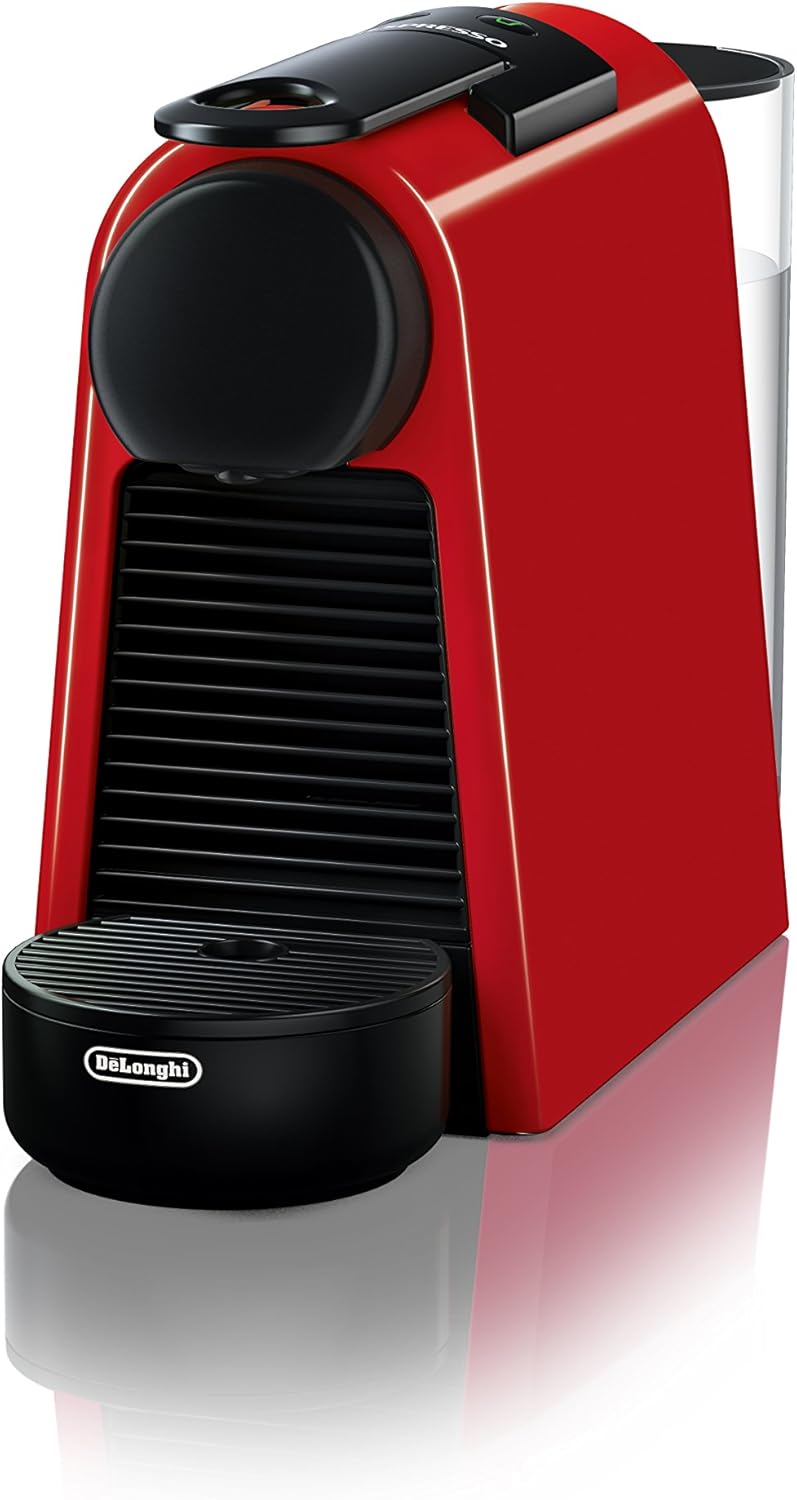
Same reliable Nespresso Essenza Mini platform — this time in a bold red finish that adds a bit of personality to your counter. The 0.6-liter water tank is a step up from the black model, meaning fewer refills between morning sessions. This version also gets a slight edge in the ratings, and it’s the one that tends to get recommended when someone wants the Nespresso experience with a little more style.
Like its black sibling, it’s built by De’Longhi and runs on the Original Line Nespresso capsule format. The manual milk system is a notable inclusion here — you’re not getting an integrated frother, but you do have the option to use a separate frother for cappuccinos and lattes. If that’s something you care about, our roundup of milk frothers for hot chocolate and cold foam lovers has a solid shortlist to pair with it.
- 0.6-liter water tank capacity
- Red finish — bold countertop style
- Nespresso Original Line capsule system
- Manual milk system compatible
- Under 30-second heat-up time
- De’Longhi manufactured
The machine heats up in under 30 seconds, keeps the workflow dead simple, and takes up almost no countertop space. And honestly, for someone who wants a reliable daily driver without any learning curve, it’s hard to argue with a 4.6 rating across thousands of reviews. Check on Amazon for current pricing — it’s frequently on sale in both color options.
| Feature | Description |
|---|---|
| Water Tank | 0.6 liters |
| Milk System | Manual |
| Capsule Format | Nespresso Original |
Frequently Asked Questions
What does PID mean on an espresso machine?
PID stands for Proportional-Integral-Derivative — it’s a type of temperature controller that continuously monitors and adjusts the boiler heat to maintain a precise, stable brew temperature. Unlike a basic thermostat, a PID reduces temperature swings to less than 1°C, which makes a measurable difference in shot consistency and flavor.
Do I really need a PID for home espresso?
Not strictly — plenty of people pull decent shots without one. But if you’re serious about dialing in your espresso, a PID removes one major variable (temperature) so you can focus on grind size and dose. It’s especially worthwhile if you’re using single-origin or light-roast beans, which are more sensitive to temperature.
What temperature should a PID espresso machine be set to?
Most home baristas start at 93°C (199°F) as a baseline, which suits a wide range of medium roasts. Light roasts often benefit from a slightly higher temperature (94–96°C), while darker roasts can go a degree or two lower. The beauty of PID is that you can experiment and repeat your results reliably.
Is a Nespresso machine good for real espresso?
Nespresso machines produce a strong, espresso-style shot with good crema, but it’s not the same as a true semi-automatic pull. The capsule system controls most variables for you, so you won’t get the same customization. That said, for convenience and consistency, they’re genuinely hard to beat — and the Essenza Mini in particular has very strong reviews.
How much should I spend on a home espresso machine with PID?
You can find capable machines with PID or PID-adjacent temperature control from around $100 to well over $1,000. For most home baristas, the sweet spot is in the mid-range — machines like the Empstorm 20 Bar offer real PID display and controls without requiring a second mortgage. Check current prices on Amazon, as these machines go on sale regularly.
Can I use regular ground coffee in these espresso machines?
For the semi-automatic machines (like the Empstorm and the IMUSA), yes — you’ll use your own ground coffee. For Nespresso machines, you’ll need compatible capsules; you can’t use loose grounds. If you want to use pre-ground coffee in a semi-automatic, grind size and freshness matter a lot — our guide covers the details on that.
What is the difference between a single boiler and dual boiler espresso machine?
A single boiler machine uses one boiler for both brewing and steaming, which means you have to wait between pulling a shot and frothing milk. A dual boiler runs separate systems simultaneously, so you can brew and steam at the same time — ideal for busy households or anyone making multiple milk drinks in a row. Dual boiler machines tend to cost more but offer significantly better workflow.