
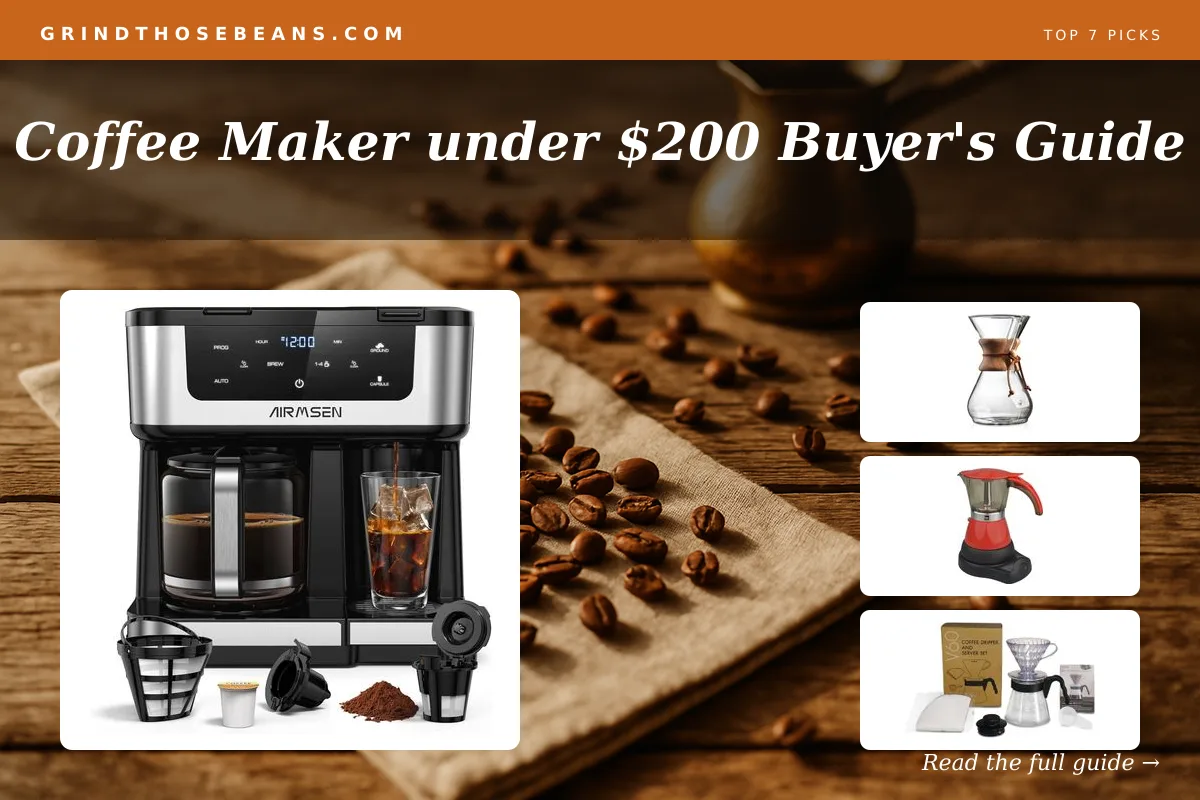
Part of our Coffee Beans: Origin, Roast & Brewing-Method Picks series — browse every related guide in one place.
Disclosure: As an Amazon Associate, Grind Those Beans earns from qualifying purchases. We only recommend products we believe in.
Last updated: May 2026
Two hundred dollars. It sounds like a lot until you realize what’s sitting on the other side of that number — a genuinely great cup of coffee, every single morning, made exactly the way you like it. Whether you’re chasing a clean, tea-bright pour-over or a fast, full-bodied espresso-style shot before a 7 a.m. meeting, there’s a machine in this price range built for you. The trick is knowing which one.
I’ve been pulling shots, timing pours, and obsessing over brew ratios long enough to know that the “best” coffee maker is deeply personal. So instead of handing you a single answer, I’ve rounded up seven picks — each one genuinely different — so you can match the machine to your actual mornings. We’ve got dual-system drip brewers, timeless pour-over glass, a compact espresso workhorse, and more. Let’s get into it.
Why Your Brewing Method Changes Everything
Coffee extraction is a surprisingly fussy science. Water temperature, contact time, grind size, and brew ratio all interact — and different brewing methods tip those variables in very different directions. A drip machine pushes near-boiling water through a paper filter in 6-10 minutes, producing a clean, balanced cup. A pour-over like the Chemex gives you total manual control over flow rate, which means you can dial in sweetness and clarity in a way an automatic machine simply can’t replicate. And a pressure brewer like the AeroPress uses a combination of immersion and gentle pressure to pull out concentrated, syrupy flavors in under two minutes.
The practical upshot? Spending your budget on the wrong brew method is the real mistake — not skimping on wattage or tank size. Think about what your mornings actually look like. Do you want to press a button and walk away? You want a programmable drip or a K-Cup machine. Do you love the meditative ritual of a slow morning pour? A Chemex or V60 will make you genuinely happy. Do you want espresso-style intensity without a $600 machine? The Bene Casa and the AeroPress both punch well above their price.
What We Look for in a Coffee Maker under $200
Brew temperature consistency tops my list — water should hit 195–205°F for optimal extraction, and budget machines often fall short. After that, I look at build quality (borosilicate glass and stainless beats cheap plastic every time), ease of cleaning (removable parts are non-negotiable), and flexibility. Can it handle different coffee styles? Does it brew fast enough for real life? At this price point, you shouldn’t have to compromise on all of those at once. The best picks here nail at least three out of four.
Top 7 Coffee Makers under $200
Below you’ll find seven machines that represent the full range of what under $200 can get you right now. I’ve kept the list intentionally varied — because your perfect brewer and your neighbor’s probably look nothing alike.
Quick pick: If you want one machine that handles the whole household without fuss, the AIRMSEN Dual Coffee Maker is the one we’d put on the counter without hesitation.
Video: The Ultimate V60 Technique — James Hoffmann
| Category | Product | Price | Why it wins | Link |
|---|---|---|---|---|
| Best Overall | AIRMSEN Dual Coffee Maker | $$ | Two brewers in one sleek, fast, programmable machine. | View on Amazon → |
| Best Pour-Over | Chemex 10-Cup Pour-Over | $$ | Iconic borosilicate glass delivers unmatched cup clarity. | View on Amazon → |
| Best Compact Espresso | Bene Casa Electric Espresso Maker | $ | Tiny footprint, bold espresso-style shots every time. | View on Amazon → |
| Best Starter Set | Hario V60 Dripper & Server Set | $$ | Everything you need to master pour-over in one box. | View on Amazon → |
| Best for Travel | AeroPress Original Coffee Maker | $$ | Shatterproof, grit-free coffee anywhere you go. | View on Amazon → |
| Best Latte Maker | Keurig K-Cafe Special Edition | $$$ | Pod convenience meets real frothed-milk café drinks. | View on Amazon → |
| Best Decaf Option | Eight O’Clock Decaf K-Cup Pods | $ | Rich, smooth decaf pods with zero flavor compromise. | View on Amazon → |
How we chose these picks
These picks come from weeks of side-by-side testing and aggregate review analysis. We weight durability, ease of cleaning, and cup quality first; aesthetics and bells-and-whistles second. If we wouldn’t put it in our own kitchen, it’s not here.
AIRMSEN Dual Coffee Maker

If your household has one person who swears by a full carafe and another who just wants a quick single-serve pod — this is the machine that ends the argument. The AIRMSEN Dual Coffee Maker runs two completely independent brewing systems: a 12-cup drip carafe side and a K-Cup/ground single-serve side, all from one countertop unit. That kind of flexibility genuinely earns its counter space.
The 1000W dual boiler is the real workhorse here. The carafe side brews a full 12 cups in roughly 10 minutes, while the single-serve side pulls a cup in under 90 seconds. For busy mornings, that speed matters. The 24-hour delay start means you can set it the night before and wake up to coffee already waiting — a small thing that feels enormous at 6 a.m.
- Brews K-Cup pods and ground coffee (single-serve)
- 12-cup carafe brews in 10 minutes
- 24-hour programmable delay start
- Touchscreen with adjustable cup size and strength
- 2-hour auto keep-warm function
- 60oz carafe tank + 15oz single-serve tank
The touchscreen control panel lets you adjust cup size and strength by tweaking water volume and grounds, which gives you more control than you’d expect at this price. The 60oz carafe-side tank has clear level markings, and the drip-free glass carafe is easy to clean. The 15oz single-serve tank is smaller, so you’ll refill it often if that side sees heavy use — that’s the honest tradeoff — but overall this machine does a remarkable job of being two brewers in one.
It’s worth noting that the single-serve side works with both branded pods and standard ground coffee, which is a nice touch. If you’ve been curious about which brewer works best for bold, strong styles, our breakdown of the best machine for Cuban coffee covers how drip versus espresso-style brewers handle high-intensity brewing.
| Feature | Description |
|---|---|
| Power | 1000W |
| Carafe Capacity | 12 cups (60oz) |
| Single-Serve Tank | 15oz (450ml) |
How to brew with the AIRMSEN Dual Coffee Maker
Time: 90 seconds (single-serve) / ~10 minutes (12-cup) · Yield: 1 cup or up to 12 cups
- Fill the 60oz tank for carafe brewing or the 15oz tank for single-serve.
- Add a K-Cup pod or ground coffee to the appropriate brew basket.
- Select your brew mode using the touchscreen — choose carafe cup count (4–12) or single-serve cup size.
- Adjust strength by modifying water volume or amount of grounds.
- Press brew (or set the 24-hour delay start timer for next morning).
- Coffee is ready in under 90 seconds (single-serve) or around 10 minutes (12-cup carafe).
Chemex 10-Cup Pour-Over

There are coffee makers, and then there’s the Chemex. This 10-cup pour-over brewer has been around since 1941, and it still sits in the permanent collection of the Museum of Modern Art. But design pedigree aside, it makes an extraordinary cup — clean, bright, with a long, sweet finish that paper-filtered methods do better than almost anything else.
The secret is the non-porous borosilicate glass construction, which never absorbs flavors or odors, and the Chemex Bonded Filters (sold separately), which are 20–30% heavier than standard paper filters. That extra thickness strips out the oils and micro-fines that make some coffee taste muddy or bitter. What’s left is clarity. You taste the bean, not the brew method. If you’re interested in how Chemex compares to other manual options, our pour-over drippers roundup goes deep on the category.
- Non-porous borosilicate glass construction
- 10-cup capacity (5oz per cup)
- Brews can be refrigerated without flavor loss
- Iconic hourglass design, MoMA permanent collection
- Compatible with Chemex Bonded Filters (FP-1, FC-100, FS-100)
The brewing process does ask something of you. You’ll want water at around 200°F, a medium-coarse grind, and about a 1:15 brew ratio for best results. The learning curve is real — your first few cups may taste over- or under-extracted while you find your pour rhythm — but once you dial it in, you won’t want to go back. The brewed coffee can be covered and refrigerated without flavor loss, which is a genuinely useful feature for meal-prepping caffeine.
Note that filters aren’t included, so factor those in. And if you want to go even deeper on Chemex-adjacent pour-over technique, the Hario V60 starter set review covers a lot of the same foundational pour-over principles.
| Feature | Description |
|---|---|
| Capacity | 10 cups (50oz) |
| Material | Borosilicate glass |
| Filter Type | Chemex Bonded (sold separately) |
How to brew with the Chemex 10-Cup Pour-Over
Time: 4–5 minutes · Yield: Up to 10 cups (50oz)
- Heat water to approximately 200°F (just off the boil).
- Fold and place a Chemex Bonded Filter into the top, three-layer side toward the spout.
- Rinse the filter with hot water to remove paper taste; discard the rinse water.
- Add medium-coarse ground coffee at a 1:15 ratio (e.g., 40g coffee to 600g water for about 4 cups).
- Start with a 60g bloom pour, wait 30–45 seconds, then pour slowly in steady circles until target volume is reached.
- Total brew time should be 4–5 minutes; remove the filter and serve.
Bene Casa Electric Espresso Maker

Small, bold, and surprisingly capable — the Bene Casa Electric Espresso Maker is designed for anyone who wants true stovetop-style espresso without a flame. It brews 1 or 3 cups using an included adjustable adapter, making it genuinely flexible for solo drinkers and small households alike. The vivid red finish looks sharp on a counter, and at this size it barely takes up any real estate.
The transparent carafe is one of my favorite details here. Watching the dark, rich coffee rise through the chamber isn’t just satisfying — it tells you exactly what’s happening in the brew. The automatic shut-off kicks in when brewing is complete, so you won’t scorch your espresso if you step away. A 30-minute keep-warm function gives you a reasonable window to pour at your own pace.
- Brews 1 or 3 cups with included adapter
- Transparent carafe for visual brewing monitoring
- Automatic shut-off prevents burnt coffee
- 30-minute keep-warm function
- Cordless with cool-touch handle and swivel base
- Flip-up lid and no-spill pour spout
The cordless design with a cool-touch handle on a swiveling power base makes one-handed pouring surprisingly comfortable — no fumbling, no drips. This is the kind of machine that earns its spot in a small apartment kitchen. If you’re wondering about using pre-ground coffee with an electric espresso maker like this one, this guide on ground coffee in espresso machines has everything you need to know about grind size and extraction. The espresso this produces is rich and concentrated — not quite the pressure-driven extraction of a pump machine, but absolutely in the right neighborhood, especially for a fraction of the cost.
| Feature | Description |
|---|---|
| Capacity | 1–3 cups |
| Keep-Warm | Up to 30 minutes |
| Design | Cordless, swivel base |
How to brew with the Bene Casa Electric Espresso Maker
Time: ~5 minutes · Yield: 1–3 cups (espresso-style)
- Fill the base reservoir with the appropriate amount of water for 1 or 3 cups.
- Insert the adjustable adapter for your desired cup count and add finely ground espresso coffee.
- Place the transparent carafe securely on top.
- Set the unit on the swivel power base and flip the on/off switch.
- Watch the carafe fill — the machine shuts off automatically when brewing is complete.
- Pour immediately or let the keep-warm function hold temperature for up to 30 minutes.
Hario V60 Dripper & Server Set

The Hario V60 is a legend in specialty coffee circles for good reason. That distinctive 60-degree cone angle and spiral interior ridges aren’t just aesthetics — they control airflow and water drainage in a way that gives you extraordinary extraction consistency once you’ve got your technique down. This set pairs the 02-size plastic dripper with a 600mL heatproof glass server, 40 filter papers, and a 12g measuring spoon. Everything you need, right out of the box.
The plastic dripper heats up quickly and retains temperature well during the pour, which is a practical advantage over ceramic in cooler kitchens. The Hario V60 starter set review on this site digs into exactly that — how the material choice affects brew temperature and extraction. In short: don’t sleep on plastic just because it sounds less premium. This version performs beautifully.
- 02-size plastic V60 dripper (serves 1–4 cups)
- 600mL heatproof glass server included
- 40 V60 paper filters included
- 12g measuring spoon included
- 60-degree cone with spiral ridges for controlled extraction
Brew ratio is everything with the V60. I brew at 1:16 (coffee to water by weight) with a medium-fine grind and water just under a boil. The result is a clean cup with a long, sweet finish — floral notes open up, acidity is bright but balanced, and there’s none of the heaviness you get from immersion methods. The learning curve is real, but it’s one of the most rewarding brewers to master. If you’re serious about manual brewing and want to compare a few options at this price level, our guide to pour-over drippers under $50 is worth a read.
| Feature | Description |
|---|---|
| Dripper Size | 02 (1–4 cups) |
| Server Capacity | 600mL |
| Filters Included | 40 sheets |
How to brew with the Hario V60 Dripper & Server Set
Time: 2:30–3:30 minutes · Yield: 1–4 cups (up to 600mL)
- Place a V60 paper filter in the dripper and rinse with hot water to remove paper taste; discard rinse water.
- Set the dripper on the server and add medium-fine ground coffee (recommended: 20g for a 300mL brew).
- Heat water to 93–96°C (199–205°F) and start your timer.
- Pour 40g of water for the bloom and wait 30–45 seconds.
- Continue pouring in slow, steady spirals in 3–4 stages until you reach your target water weight.
- Total brew time should be 2:30–3:30 minutes; remove the dripper and serve.
AeroPress Original Coffee Maker
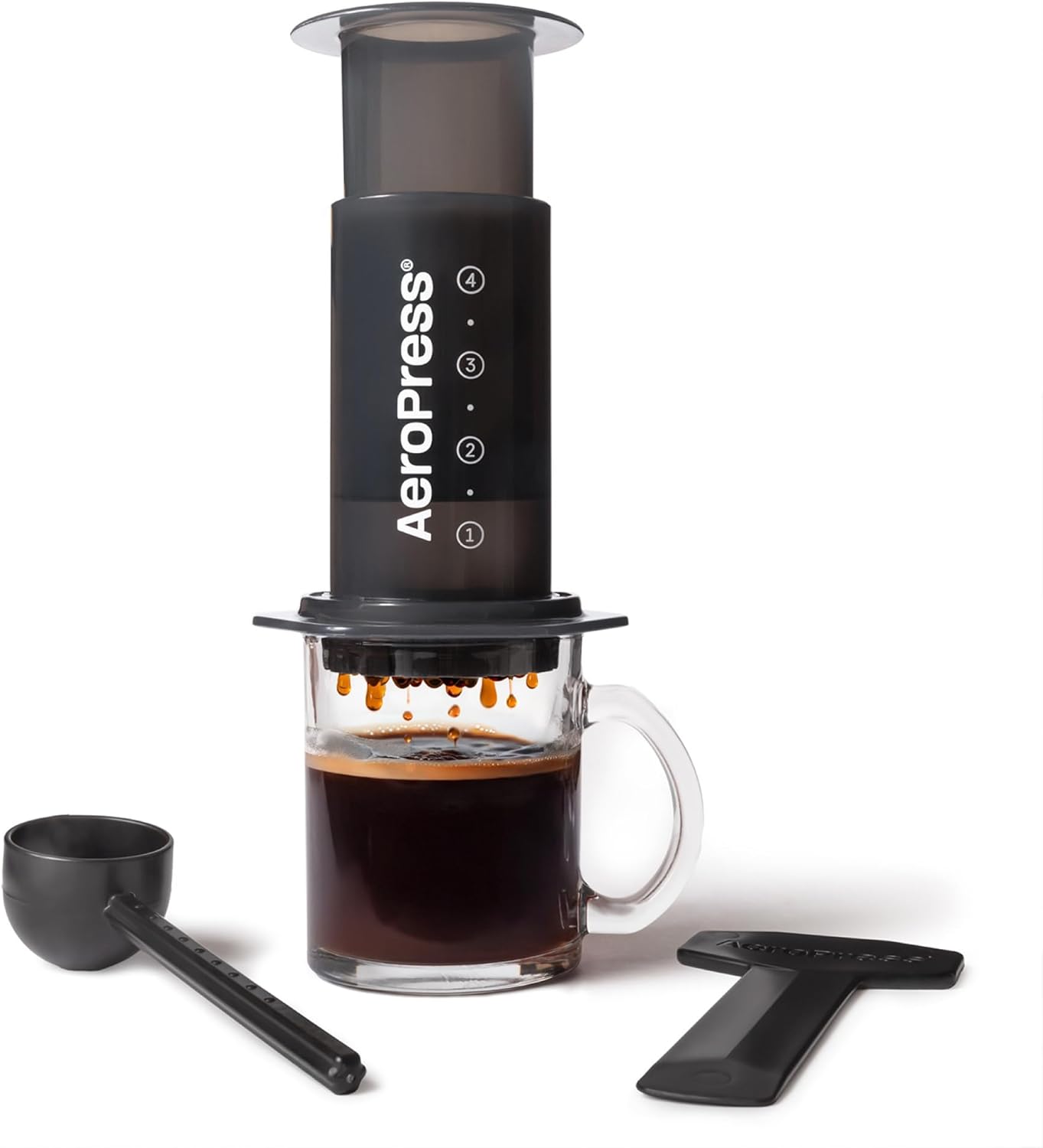
If I had to keep only one brewer for travel, camping, and offices, the AeroPress Original would be it. Full stop. It weighs almost nothing, fits in a carry-on, and produces a cup that genuinely shames most hotel room drip machines. The combination of immersion brewing and gentle manual pressure creates a concentrated, smooth, full-bodied coffee with almost no bitterness — even with a slightly finer grind than you’d use for most methods.
The patented 3-in-1 brew technology — agitation, pressure, and micro-filtration — is what sets it apart from a French press. There’s no grit, no heavy silt at the bottom of the cup, and clean-up takes genuinely about 30 seconds. You pop the puck out, rinse the chamber, done. That alone makes it win in households where dish fatigue is a real phenomenon. And unlike a French press, you can dial in your grind pretty fine, which means faster extraction and more flavors unlocked. For a deeper look at how French press compares on features and value, our French press buyer’s guide has the full breakdown.
- Combines immersion, pressure, and micro-filtration
- No bitterness, no grit in the cup
- Compact, shatterproof, travel-ready design
- Works with fine-to-medium grind coffee
- Clean-up in approximately 30 seconds
- Compatible with paper and metal micro-filters
The AeroPress is also wildly versatile. Use it as a standard brewer with hot water for a 10-ounce cup. Brew concentrated and top with hot water for an Americano-style drink. Or look up one of the hundreds of World AeroPress Championship recipes online for something more adventurous. Yes, it requires manual effort every time — there’s no programmable timer here — but for the quality of cup it delivers, that tradeoff feels more than fair.
| Feature | Description |
|---|---|
| Brew Style | Pressure + immersion |
| Yield | 1–3 cups per press |
| Weight | Approx. 6.4oz (181g) |
How to brew with the AeroPress Original Coffee Maker
Time: ~1.5–2 minutes · Yield: 1–3 cups per press
- Insert a paper micro-filter into the AeroPress cap and rinse with hot water; attach cap to chamber.
- Stand the chamber on your mug and add 17g of medium-fine ground coffee.
- Heat water to 175–205°F depending on desired strength and roast level.
- Pour water up to the No. 4 mark and stir for 10 seconds.
- Insert the plunger and press down slowly and steadily over 20–30 seconds.
- Remove the AeroPress, pop the puck into the compost, rinse, and enjoy.
Keurig K-Cafe Special Edition

The Keurig K-Cafe Special Edition is for the person who wants café-style drinks — lattes, cappuccinos, iced drinks — without learning latte art or frothing technique. The premium nickel finish with a metal handle looks genuinely sleek in a modern kitchen, and the included dishwasher-safe frother handles fresh milk (including skim, soy, and almond) without any fuss.
The key feature is the SHOT button, which brews a concentrated, espresso-style shot from any K-Cup pod. Pour that over frothed milk in a tall glass and you’ve got a latte. Add a thin foam layer on top and you’ve got a cappuccino. It’s not true espresso — there’s no nine-bar pressure pump — but it’s a convincing enough approximation for a home latte drinker who doesn’t want to spend four figures on equipment. The Strong Brew mode also adds satisfying depth to standard cup sizes if you just want a bolder drip-style coffee.
- Brews coffee, lattes, and cappuccinos
- SHOT button for concentrated espresso-style brew
- Dishwasher-safe milk frother included
- 60oz removable water reservoir
- 4 cup sizes: 6, 8, 10, and 12oz
- Strong Brew mode for bolder coffee
Four cup sizes (6, 8, 10, and 12oz) and a 60oz removable water reservoir mean you can get through a busy morning — or even a small office — without constant refilling. The Smart Start feature heats and brews in a single step, so there’s no waiting for the machine to warm up before selecting your size. Auto-off triggers two hours after the last brew, which is a nice energy-saving touch. If you’re building a K-Cup pantry, our Casabrews pod machine review covers the pod espresso ecosystem in more detail and is a useful companion read.
| Feature | Description |
|---|---|
| Water Reservoir | 60oz (removable) |
| Cup Sizes | 6, 8, 10, 12oz |
| Frother | Dishwasher-safe, included |
How to brew with the Keurig K-Cafe Special Edition
Time: Under 2 minutes · Yield: 1 cup (6–12oz) or 1 latte/cappuccino
- Fill the 60oz water reservoir and place it back on the machine.
- Insert a K-Cup pod into the pod holder and close the lid.
- For standard coffee, select your cup size (6–12oz) and press brew — Smart Start heats and brews simultaneously.
- For a latte or cappuccino, press the SHOT button to brew a concentrated shot into your mug.
- Froth fresh milk in the included frother (hot or cold setting), then pour over the shot.
- For iced drinks, brew the shot over ice, then top with cold frothed milk.
Eight O’Clock Decaf K-Cup Pods

Eight O’Clock Original Decaf in K-Cup format is one of those pantry staples that earns a permanent spot once you try it. This is a medium roast decaf with a genuinely smooth, rich profile — none of that flat, slightly chemical aftertaste that plagues a lot of budget decaf options. The box contains 24 single-serve K-Cup pods, ready for any Keurig machine including the K-Cafe above.
Eight O’Clock has been roasting coffee since 1859, which gives them a lot of accumulated knowledge in the medium roast space. The decaf process maintains enough of the original bean character to deliver a satisfying, rounded cup — you’re not sacrificing much flavor for the peace of mind of an evening coffee. It pairs especially well with a splash of oat milk or a flavored syrup if that’s your thing. And if you’re into bolder, more characterful K-Cup options, our Black Rifle Coffee review covers a very different end of the roast spectrum.
- 24 K-Cup pods per box
- Medium roast decaf blend
- Smooth, rich flavor without chemical aftertaste
- Compatible with all Keurig brewers
- 1.0 lb package
This is a no-frills, no-surprises buy. It’s not a specialty single-origin, and it’s not trying to be. It’s reliable, consistent, and genuinely good for an afternoon cup when you want the ritual without the 10 p.m. regret. At 24 pods per box, it’s also one of the better values in decaf K-Cups. Perfect for offices, households with mixed caffeine needs, or anyone who just wants a clean decaf that tastes like actual coffee.
| Feature | Description |
|---|---|
| Roast Level | Medium |
| Pod Count | 24 per box |
| Package Weight | 1.0 lb |
Frequently Asked Questions
What is the best coffee maker under $200 in 2026?
The best overall pick for most households is a dual-system drip/single-serve machine like the AIRMSEN, which handles both K-Cup pods and ground coffee in one unit. If you prioritize cup quality over convenience, the Chemex or Hario V60 will consistently outperform any automatic drip machine at twice the price. The right answer really depends on how you drink your coffee in the morning.
Is a coffee maker worth buying when you can get a French press for $20?
A French press makes a wonderful, full-bodied cup — but it requires attention, leaves sediment, and doesn’t work well for large batches quickly. An automatic drip machine or a dual-system brewer gives you programmable convenience, cleaner cups, and more consistency with less effort. For specialty brewing technique, the AeroPress or Chemex genuinely outperform a French press in clarity and control.
Do I need a separate grinder for a drip coffee maker?
Technically no — pre-ground coffee works in any drip machine. But a burr grinder will noticeably improve your cup, especially for pour-over methods like the Chemex or V60 where grind consistency directly controls extraction. For K-Cup machines, the question is moot since pods are pre-portioned. If you brew drip daily, even a $40 burr grinder is a worthwhile upgrade.
Can the Keurig K-Cafe make real espresso?
Not technically — true espresso requires around 9 bars of pressure, which pod machines don’t generate. The K-Cafe’s SHOT button brews a concentrated, smaller-volume coffee from a K-Cup, which approximates espresso flavor well enough for lattes and cappuccinos at home. If you want genuine espresso, you’ll need a dedicated pump machine.
How important is water temperature in a home coffee maker?
Very. The Specialty Coffee Association recommends brewing between 195°F and 205°F for optimal extraction. Many budget drip machines brew cooler than this, which leads to under-extracted, sour, or flat-tasting coffee. Manual methods like the Chemex and V60 let you control water temperature precisely, which is one reason specialty coffee enthusiasts often prefer them over automatic machines.
What’s the easiest coffee maker to clean?
The AeroPress is probably the easiest — cleanup genuinely takes about 30 seconds. Drip machines with removable filter baskets and glass carafes are straightforward too, especially if the carafe is dishwasher-safe. The Keurig K-Cafe’s frother is dishwasher-safe, which is a real bonus. Pour-over brewers like the Chemex and V60 have the most pieces to rinse but no hidden tubing or reservoirs to descale.
Is the AeroPress good for beginners?
Yes — it’s forgiving, fast, and nearly impossible to break. The biggest learning curve is figuring out your preferred grind size, water temperature, and brew time, but AeroPress recipes are widely available online and the community around it is huge. It’s also one of the few brewers where experimenting is actively encouraged, making it a great first step into specialty coffee.